Gut Instinct, Market Data, And Store Behavior Add Up To Usable Product Intelligence
Meredith Diehn, SVP of Marketing at goodwipes, says gut should carry the big directional calls, with research reserved for what preference would otherwise decide.
Make The Intelligence Record one of your go-to sources on Google


When we have big picture opportunities, gut is usually the right thing. We can get probably 70 to 80% on gut, and then finally, we need data. Let's take our personal bias out of this.

Most consumer brands collect more signals than they can act on. Help-desk messages, social replies, syndicated category data, retail sales reports, and shopper research arrive on different schedules and land with different teams. Reconciling them usually falls to whoever has capacity. Larger organizations answer this with process, adding review layers that slow a decision down until the opportunity has cooled. What separates teams that convert signal into product is rarely the volume of data they hold. It's how few steps sit between noticing something and deciding to act on it.
Meredith Diehn is the SVP of Marketing at goodwipes, the flushable wipes brand that's spent more than a decade arguing the category deserved a real consumer brand. She joined the company after nearly twenty years in large-scale consumer packaged goods, including eight at PepsiCo across Tropicana, Quaker and nutrition innovation. There, Diehn managed a media budget above $75 million and ran P&L on a billion-dollar oatmeal and snacks business. Her current team is under thirty people, and she argues that constraint is the advantage.
"When we have big picture opportunities, gut is usually the right thing. We can get probably 70 to 80% on gut, and then finally, we need data. Let's take our personal bias out of this," says Diehn. The order of business does more work than the ratio. Directional calls come first and fast, built on category familiarity and time spent watching shoppers. Research arrives afterward and narrowly, to settle the questions a room full of marketers would otherwise answer for itself, like what a new product should be called.
Input from the inbox
goodwipes often hears from its customers without having to ask. They write in through social channels and the company's own inbox, and the volume accumulates into a standing record of what the category still doesn't offer. "We look to our community a lot," Diehn notes. "They're always DMing us, sending emails to our general help desk of, 'Hey, have you ever come out with this?' Or, 'We've had flavors in the past that we've retired, seasonals where they're saying, can you bring it back?'"
The brand benchmarks itself against personal care, not paper goods, so the relevant scent comparisons sit in body wash, lotion and soap. Vanilla ranks near the top across all three, which explains the volume of requests arriving and pointed at an opening the category had left. "There actually isn't a vanilla scented wipe in the flushable wipe category yet," Diehn says. "This is the first of its kind."
An hour in the aisle
Store visits are written into how the goodwipes team works, and Diehn does them herself. She treats watching what shoppers reach for as a check on any conclusion formed in a conference room, and as a faster read than most commissioned research. The point is to notice what the category's already trained people to expect. "We have a lot of leaders, including myself, that prioritize a lot of time in store just walking the aisles, talking to consumers," she explains. "You could probably walk and spend an hour just observing people in a Walmart or a Target, and half of them would buy vanilla scented something."
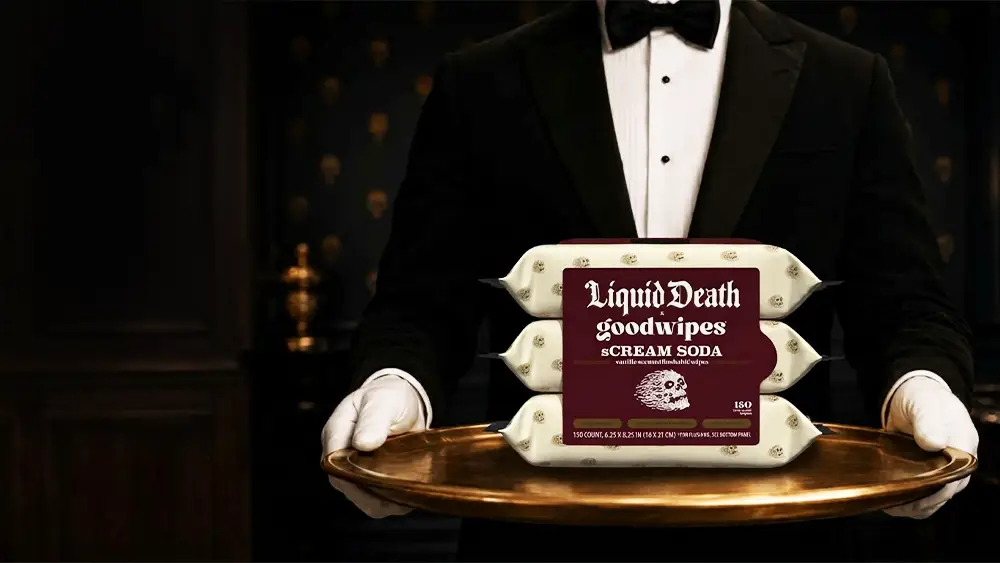
Walmart supplied a signal goodwipes hadn't gone looking for. After seeing the influencer boxes the brand assembles for each launch, the retailer asked to sell one, turning a media seeding tactic into a stocked item. The latest three-piece bundle carries a wipes pack, a can of Liquid Death sCREAM Soda, and a crewneck, priced under twenty dollars against a stated value above fifty. Diehn frames the retailer request as its own signal about where consumer appetite had moved. "Retailers are starting to lean into this too," she notes. "What used to be given to only a select number of influencers or sent out to media, now the public can buy and get this limited edition exclusive merch as well."
Alignment over agreement
Reading a signal early only helps if the company can act before the window closes. At an emerging brand like goodwipes, the people who can approve a product are reachable the same week the question arises, compressing a cycle that would run a full quarter elsewhere. Diehn credits headcount for that, and she's clear it isn't a superior process. "The beauty of being a brand with a very lean team is that we don't have a lot of cooks in the kitchen," she says. "We can field a survey, get it back in two days, and get the decision makers on Google Meet within a day and say, okay, let's move, let's make decisions."
Consensus also isn't a requirement before a decision gets made at goodwipes. A room that doesn't agree can still commit, provided everyone's read the same evidence and accepts who owns the outcome. Diehn treats that distinction as central to how the team functions. "We talk a lot about accountability over agreement," she explains. "We don't necessarily all have to agree, but we all look at the data and we all say, okay, we have alignment, so we are all going to align to move forward."
Planning the next act
Revenue remains the terminal number, though Diehn reads earlier indicators to judge whether a launch is building anything that'll last. Earned media sits alongside them, and together they tell her whether the brand's footprint has widened past the campaign window. She treats the combination as the best available predictor of whether a second act is possible. "We look at a lot of different signals such as 'Are we generating user generated content?'" she notes. "We look at things like Google search trends and our organic followers. Are people talking about goodwipes more than they were before?"
The sCREAM Soda wipes sit in aisle at 4,000 Walmart stores through January 2027, roughly six months against the eight-week end-cap run a limited-time offer usually gets. The longer runway converts a launch spike into a sustained demand problem, and turns the marketing job from generating attention once into renewing it repeatedly. "It's on us as a brand to continue to generate that interest so people will go into the aisle and shop," Diehn concludes. "We have to do a lot, and it's a big focus for us over the next few months to keep that interest and ask for consumers to be buzzing about it."