Linear TV Was Supposed to Be Dying. Now the 2026 World Cup Is About to Reprice It for One Summer.
FIFA is on track for a record $13 billion cycle and the two US broadcasters to roughly double their 2022 World Cup haul, but the spike is a 39-day pop-up. It's a stress test of whether scarce live attention can still command the prices the rest of television gave up trying to charge.
Make The Intelligence Record one of your go-to sources on Google

For most of the past decade the loudest argument in television advertising has been that the audience was leaving, fragmenting across streaming apps and ad-free tiers until linear inventory stopped commanding a premium worth fighting over. The 2026 World Cup is about to settle that argument for one summer, and the verdict cuts against the people who declared linear dead. FIFA's own financial report projects record revenue of $13 billion dollars for the cycle ending with this tournament, a 72 percent jump over the previous four years, and the American broadcasters carrying the matches are on track to roughly double what they made on the last World Cup. Scarcity, it turns out, is the only thing in this market that still has pricing power, and a 39-day event is where that scarcity gets priced in public.
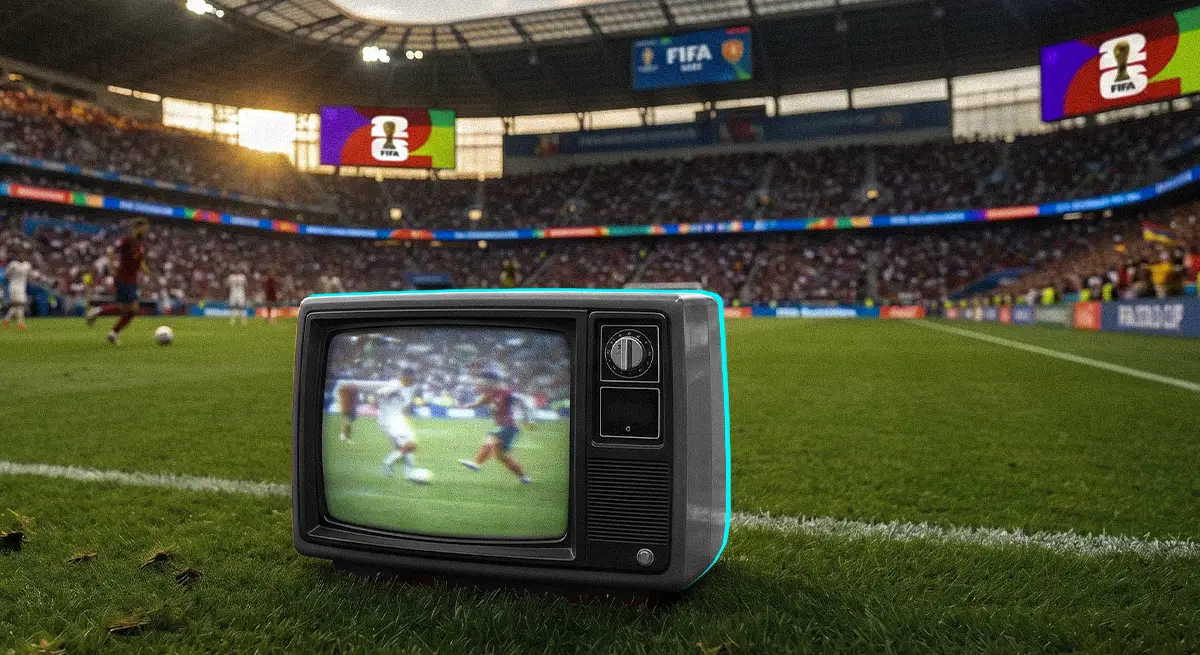
Frank Cooper III, the chief marketing officer at Visa, gave the dynamic its sharpest name. The World Cup, he wrote in announcing Visa's tournament campaign, "is a pop-up economy. One day it's here, and the next day it's gone." That's the right way to read the numbers, because a pop-up economy doesn't behave like a season. A season spreads inventory across months and lets demand find a comfortable clearing price. A tournament compresses a year's worth of marquee live audience into six weeks across three host countries, then folds up. Brands that want in have to commit early and pay forward, which is why so much of the spending was locked before a cleat ever hit the pitch.
Sports Became the Load-Bearing Wall of Television
The macro backdrop is what makes the spike legible rather than freakish. EMARKETER's first sports advertising forecast put US sports TV ad spending at roughly $20 billion in 2027 and nearly $24.83 billion by 2030, which would be close to a quarter of an $87 billion converged TV market, growing about four times faster than the converged market overall. Sports has become the load-bearing wall of television advertising, and the World Cup is not a departure from that trend. It's the trend arriving all at once, a single inventory that for a few weeks behaves like the most valuable real estate on American screens.
The scale of the jump is the part that should make buyers sit up, because it is concrete and it depends on which baseline the comparison uses. Four years ago the two US rightsholders, Fox and Telemundo, took in a combined $282 million from the Qatar tournament, $146 million on Fox and $136.1 million on Telemundo. This time the same two networks are projected to pull in around $850 million combined, up from $384.3 million in 2018, the last World Cup played in its usual summer window. Measured against the 2022 combined haul, the projected $850 million is closer to a tripling; measured against the 2018 summer-window figure of $384.3 million, it's roughly a doubling. Those are not the same comparison, and the difference matters because the two baselines are not interchangeable. That puts a single soccer event in the revenue neighborhood of a Super Bowl. NBCUniversal said its Spanish-language network Telemundo was already 90 percent sold out nearing the end of 2025, with advertiser spend doubled since 2022 and the largest deals in Spanish-language history. All of it loaded into a window measured in weeks.
What Scarcity Looks Like When the Seller Has the Only Product
Step back from the broadcasters and the same pressure shows up at the league's own cash register. The Guardian, walking through FIFA's balance sheet, reported the $13 billion cycle as a 73 percent rise over the $7.5 billion Qatar generated, with sponsors and partners contributing a record haul. FIFA closed out its commercial program before the tournament began. Its chief business officer, Romy Gai, said the last of the 16 global sponsorship positions had been allocated, calling it the most successful commercial program in the governing body's history and the highest sponsorship revenue ever recorded by a standalone sporting event. Ampere Analysis pegged 2026 sponsorship at as much as $2.4 billion, a 37 percent increase on 2022. Sold-out inventory at record prices is what scarcity looks like when the seller has the only product.
That scarcity is what every advertiser is now paying around. Marriott put access to all 104 matches and more than 600 experiences into a single campaign it called its largest activation ever for one event. Walmart, which holds no FIFA rights at all, has been building toward the moment by betting that US soccer is becoming a ritual audience. Demand of that intensity, from rights holders and non-rights-holders alike, met by inventory that cannot expand, is the definition of a price spike.
A Spike, Not a Tide
What keeps this from reading as a structural reordering of where ad dollars live is its size relative to the whole. The US World Cup ad market sits at roughly $400 million to $500 million inside a $60 billion to $70 billion TV ecosystem. Global advertiser spend to reach World Cup viewers may hit $10.5 billion, which is nearly double the $5.7 billion spent across an entire NFL season, but the incremental lift on the broader US ad market is closer to $500 million.
Set against a TV market that size, the tournament is a spike, not a tide. It moves the price of a narrow slice of inventory to extraordinary levels for a brief stretch, then the slice disappears.
The Objection That Should Confirm Streaming, But Doesn't
There's an honest objection sitting underneath the celebration, and it's worth holding open rather than waving off. The dominant story of the past several upfront seasons has been the migration to streaming, the idea that connected TV is where attention and eventually the money are headed, one front in a broader repricing of how audiences are counted and sold. The World Cup undercuts that story at exactly the moment it should be confirming it.
Ross Benes, the EMARKETER analyst behind the sports forecast, has been blunt that the streaming narrative is overstated where it matters most. Linear TV networks, he wrote, still account for about 90 percent of time spent watching live sports even though linear is less than half of all video time on TV screens. So the demand concentrates on Fox and Telemundo rather than dispersing across platforms, which is exactly why two networks can capture nearly a billion dollars between them. The premium is real precisely because the broadcast bottleneck is real, and the pricing power follows the bottleneck.
Thirty-Nine Days, No Second Window
The tournament's structure only tightens it. Fox is carrying all 104 matches across its networks, with 70 on the broadcast channel alone, more than double what it aired in 2022. Thirty-nine days is the entire shelf life of the inventory. There is no second window, no make-good season, and no chance to buy the audience back in the fall, which is what lets sellers hold firm on price in a way no recurring property can.
That's the resolution the numbers point to. The World Cup is not proof that television advertising has found a new growth engine, and it's not proof that the medium is dying. It is a stress test of a single proposition, that scarce live attention can still command prices the rest of the market gave up trying to charge. The brands paying toward $850 million to two networks and filling all 16 of FIFA's global slots are not betting on a new baseline. They are paying the premium a pop-up charges when it knows it will be gone by morning. Once the tournament ends on July 19, the inventory vanishes, and the only durable lesson is the one the scarcity made unavoidable: when the audience cannot be replaced, the price is whatever the seller decides it is.