Signal Integration Anchors Advil's Rewriting Pain Campaign From Research To Measurement
Natalie Halpern, Senior Director of Marketing for Advil at Haleon, shares the multi-signal discipline that shaped Advil's Rewriting Pain campaign, from consumer research through talent selection to measurement.
Make The Intelligence Record one of your go-to sources on Google


Sports culture is where we see so much of that pushing and fighting through pain. We saw a real opportunity for Advil to show up and challenge that conversation and get consumers to start thinking differently.

Long before the World Cup arrived in the U.S., Advil's marketing team was reading a cultural fissure that had been widening in sports for years. Wakefield Research commissioned by the brand put the gap in numbers: 87% of athletes agreed that sports culture treats pain as a required part of success, while 67% disagreed that playing through pain benefited athletic goals or performance. The signal was that athletes were being told one thing by the culture around them and had come to believe something different. Advil was positioned to enter the conversation with a product-level argument that connected.
Natalie Halpern, Senior Director of Marketing for Advil at Haleon, oversees the brand's $800M U.S. business with full P&L responsibility. With two decades of CPG operating experience behind her, she has built a working model around integrating multiple consumer and cultural signals into strategic decisions before campaign construction begins. The approach helped her deliver Centrum's first full year of share growth in over five years, and it produced Advil's "Rewriting Pain" campaign, recognized by Haleon's CHPA Most Innovative Brand Marketing Campaign award.
"Sports culture is where we see so much of that pushing and fighting through pain. We saw a real opportunity for Advil to show up and challenge that conversation and get consumers to start thinking differently," says Halpern. The Wakefield data traced where the pressure was coming from as well: 88% of athletes reported hearing phrases like "no pain, no gain" from coaches or trainers, which located the cultural signal inside the specific authority relationships driving athlete behavior.
The campaign that resulted was built around a series of connected signals rather than a single insight. The cultural signal (athletes questioning the expectation to play through pain) gave the brand a conversation to enter. The venue signal (the U.S.-hosted World Cup as the summer's dominant cultural moment) gave that entry a natural time and place. Halpern's team treated these as inputs to a single strategic decision, where any one signal alone would have been insufficient to justify the investment.
Reading the physical-media signal
The channel signal came next. Halpern's team had been watching consumers pull back from digital saturation and start looking for reasons to be present in the world around them. The campaign responded with a physical anchor in New York City paired with an out-of-home run across the city, working from the theory that a well-placed physical ad could now compete for attention against the phones people were trying to put down. "Consumers are looking for brands and messages to fit into their lives and find them where they are," Halpern says.
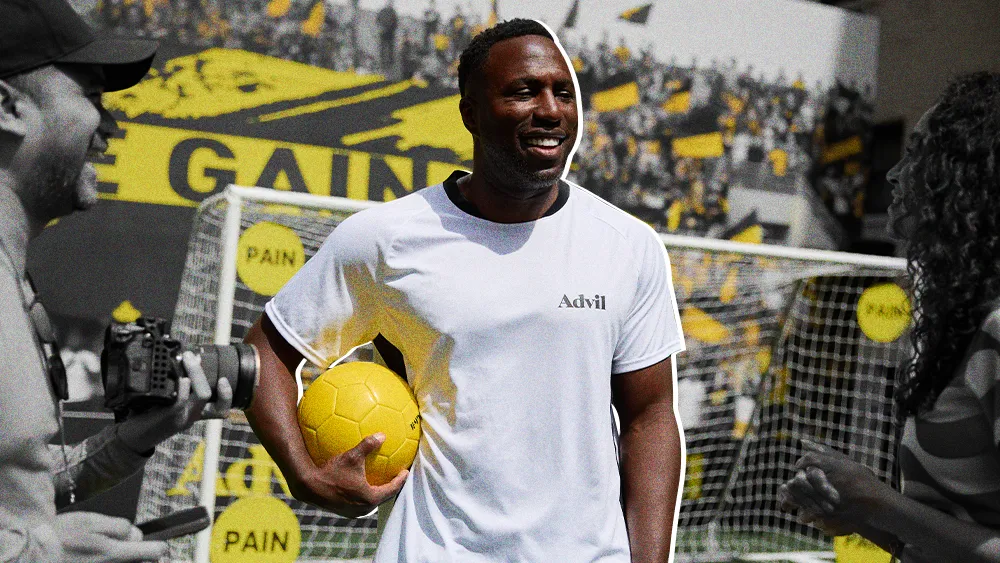
The physical activation was engineered to double as a content engine for the digital layer, with soccer drills running on-site while influencers filmed continuously and social assets accumulated in real time. The mechanic was chosen with as much analytical care as anything else in the campaign. It had to work both as a live activation and a clear physical translation of Advil's clinical differentiation from other pain relievers. "Some of the design of the drills that we had on site were literally kicking a soccer ball at targets that said 'pain', really reinforcing that idea that Advil works differently," Halpern notes.
The lived-experience criterion
Talent selection followed the same multi-signal discipline. Halpern's team evaluated former U.S. men's national team striker Jozy Altidore against multiple criteria of fit: his lived experience playing through pain, his existing use of the product, and his articulated agreement with the campaign's argument. Wakefield's finding that 78% of athletes had played through pain to avoid letting others down helped clarify why the lived-experience criterion carried the most weight in the evaluation. "His ability to bring authenticity and credibility to the conversation was critical," says Halpern. "You could feel it in the space that people were connecting and were hearing him."
The Altidore partnership functioned as the human connective tissue across the flywheel: he anchored the in-person event with a lived-experience narrative, appeared in the out-of-home creative, and generated social content that carried his story into digital distribution. Halpern's team treated his voice as the specific mechanism that could name a wider cultural problem the campaign worked to open up. "Keep going, get back up. Those toxic attitudes have infiltrated sports from youth sports to elite sports," Halpern notes.
Testing the strategic thesis
Advil's measurement framework mirrors the front-end signal discipline. Immediate commercial signals (sales performance and share of the pain relief category at weekly and quarterly cadence) run alongside longer-arc brand-health signals, including whether the brand's point of differentiation on inflammation-targeting is registering in consumer perception. Running both cadences in parallel is deliberate because either signal alone would miss the strategic question the campaign is trying to answer. "That's our point of difference, and one of our top jobs on the brand is to make sure that consumers start to understand that," Halpern notes.
Halpern treats the campaign as an early test of a broader thesis about strategic signal integration, and is watching the data across cadences to see whether the assumptions that drove the construction hold up in consumer response. "I think I know the answer to that question, but we'll continue to get that data back and see over coming months just how much of a swing that has made for us," Halpern concludes.
Advil and Wakefield Research surveyed 1,000 U.S. adults (18+) who are current and former athletes in May 2026 with a web-based questionnaire. “Athletes” were defined as those who currently compete or have competed in a sport previously (e.g. collegiate, club, recreational, etc.). The respondent pool does not include professional athletes.