The FDA Said the Lettuce Was Clean. The Recall Stayed Anyway. Yum! Just Had Its Worst Week Since 2020.
Taco Bell lost nearly 30 percent of a Saturday's traffic before a single lab test confirmed the source. Fast food's real supply-chain risk is the gap between accumulating evidence and certifying it.
Make The Intelligence Record one of your go-to sources on Google


Equity markets update continuously. Corporate disclosure updates once a quarter. If your supply-chain intelligence only updates when the 10-Q does, you're reading yesterday's newspaper.
An FDA lab reported a positive result on a sample of Taylor Farms de México iceberg lettuce, then reclassified it as a false positive a day later after its own experts re-reviewed the finding. The epidemiological and traceback evidence pointing to that same lettuce did not move. The FDA still had no confirmed positive product sample, and the recall stood anyway.
That reversal is a small event inside a much bigger story. The CDC has logged 4,173 laboratory-confirmed domestic cyclosporiasis cases since May 1, reported across 41 states, along with 308 hospitalizations, no deaths, and more than 7,400 additional cases still awaiting confirmation. A separate, smaller subset of that total, 1,644 people across Indiana, Kentucky, Michigan, Ohio and West Virginia with 94 hospitalizations, reported both a Cyclospora infection and Taco Bell exposure. The FDA traceback converged on Taylor Farms de México as the supplier of the shredded iceberg lettuce served at the implicated locations. Taco Bell dropped that supplier's lettuce. The market reacted before a single earnings statement was filed.
Walter Pollard owns the supply-chain and supplier-management beat at Polaris I/O, a decision-intelligence platform built to track exactly this kind of event as it unfolds. According to him, that reversal exposes a mistake companies keep making about what a food-safety investigation actually requires. "The lab result flipped from positive to false positive overnight. The traceback evidence didn't move an inch," Pollard says. "That's the tell: causation and precaution are two different thresholds, and companies that wait for the first before acting on the second are always going to be late."
The tier 1 blind spot
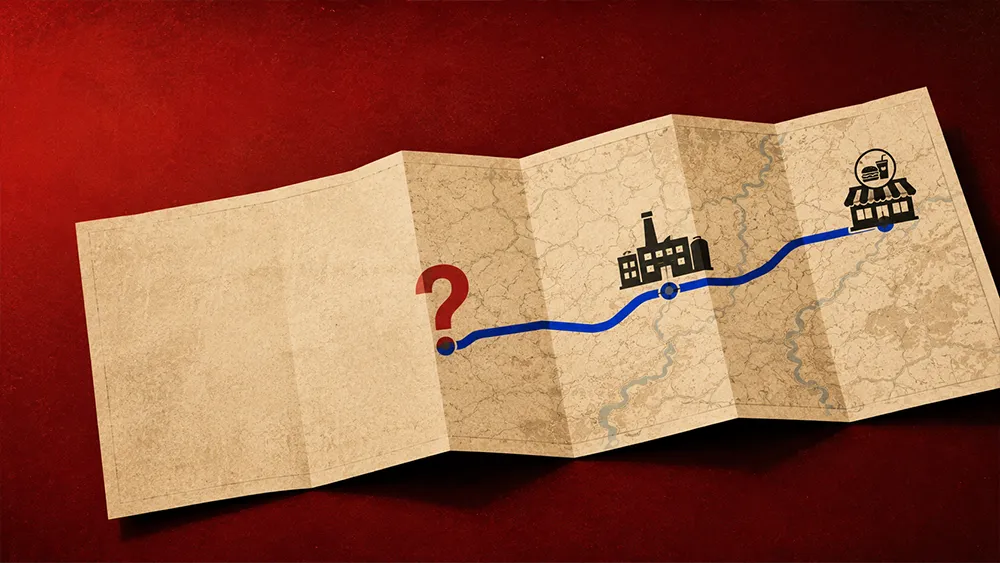
Pollard's broader argument is about where companies stop looking. A conventional supplier-risk system maps a restaurant back to its approved produce processor and calls that visibility. "Every fast-food supply chain has a Tier 1 map: who's the processor, who's the distributor," he says. "Almost none of them have a Tier 2 map: which field, which water source, which harvest crew. Cyclospora doesn't live at Tier 1. That's exactly where the visibility runs out."
Cyclospora cayetanensis is a parasite, not a bacterium, and it behaves differently than the pathogens most restaurant supply chains are built to catch. Cooking kills it, but lettuce, herbs and berries are eaten raw. Routine wash-water sanitation doesn't reliably eliminate it once it has entered the environment. Its risk factors sit upstream of the processor entirely: agricultural water sources, nearby wastewater activity, worker hygiene on the farm, the harvest window a given lot came from. A supplier-risk model that stops at "which processor shipped the lettuce" cannot answer any of those questions, and in this outbreak, that was the gap the FDA's investigators had to close manually, lot by lot.
A recurring risk, not a novel one
Fast food has been here before. A 1996 outbreak tied to Guatemalan raspberries sickened more than 900 people in the US and Canada, and outbreaks recurred the following year despite new farm controls. A 2013 investigation traced separate Cyclospora pathways to a Taylor Farms de México salad mix served at Olive Garden and Red Lobster locations and, separately, to cilantro from Puebla, Mexico, showing that a single national case surge can mask more than one outbreak at once. A 2018 outbreak linked to McDonald's salads produced 511 confirmed illnesses across 15 states, and McDonald's pulled salads from roughly 3,000 locations after tracing the source to a single processing facility. A Fresh Express bagged-salad outbreak two years later sickened 701 people; investigators found Cyclospora in a Florida agricultural canal without ever establishing a genetic match to the clinical cases.
The throughline across three decades of these events is the same one Pollard points to: the industry keeps discovering its Tier 2 and Tier 3 exposure after the fact, case by case, rather than mapping it in advance.
The market priced the disruption before the P&L did
The financial signal arrived faster than the epidemiological one. Yum! Brands shares fell roughly 10 percent over seven trading sessions, the stock's worst seven-day stretch since 2020, erasing several billion dollars of market value. Taco Bell's traffic fell 29.8 percent on a single Saturday against its average Saturday from earlier in the year. That demand collapse landed before Yum had reported a single dollar of realized impact in an audited filing. "That's not a coincidence," Pollard says. "Equity markets update continuously. Corporate disclosure updates once a quarter. If your supply-chain intelligence only updates when the 10-Q does, you're reading yesterday's newspaper."
That gap between market reaction and financial disclosure is not a reason to panic. It is a reason to distinguish, continuously, between what evidence supports precaution and what evidence would be needed to assign blame. That's the same distinction the lab reversal forced the FDA to make in public.
Waiting on the rule won't fix the gap
Regulation is moving toward the traceability Pollard describes, just not quickly. The FDA's Food Traceability Rule would require the kind of lot-level, farm-to-restaurant data that could have shortened this investigation, but Congress directed the FDA not to enforce it before July 2028, two years later than originally planned. That leaves a multi-year window where the only companies with lot-level visibility into their Tier 2 and Tier 3 suppliers are the ones that build it voluntarily.
It's the same decision-speed problem Polaris founder and CEO Dave Irwin has described in the broader case for collapsing the distance between signal and action: the edge moved from who sees the signal first to who converts it into a decision fastest. In food safety, that conversion has to happen before a lab test exists to confirm it. Not after.
This outbreak will eventually resolve into a settled narrative: a supplier, a region, a recall, a recovery curve. What it's demonstrating in the meantime is that the costliest part of a disruption event isn't the recalled product. It's everything a company doesn't know yet: which lots, which farms, which other customers received the same harvest, while the market, the regulators and the customers decide anyway.