How Enterprise Marketers Are Rebuilding Comms Workflows Around Context-Aware AI Systems
Frances Ward, VP of Corporate Marketing & Communications at Asana, is building context-aware AI systems that help communications teams connect external events to internal strategy.
Make The Intelligence Record one of your go-to sources on Google


I think there’s this human nuance to how communications comes together. There’s this real human ability to understand what’s interesting, where you pull back, and where you go for it.

While some communications teams are still treating AI like a faster copywriter, others are starting to build systems that function more like strategic teammates. At Asana, that shift shows up in a daily 7 a.m. briefing dashboard that scans external news, cross-references it against company priorities, and flags relevant internal milestones sitting on the calendar. The experiment points toward a larger evolution happening inside communications workflows: AI becomes substantially more useful when it understands organizational context well enough to connect outside events directly to internal decision-making.
Frances Ward, Asana's VP of Corporate Marketing & Communications, built the company's AI-powered morning briefing system as part of a broader effort to rethink how communications teams process information at scale. Ward brings more than two decades of experience across enterprise technology and high-stakes corporate communications, including helping lead communications strategy around Dynatrace's $14.4 billion IPO and shaping quarterly earnings narratives. At Asana, she developed a custom AI-driven media intelligence tool that saves her department over $110,000 annually while contributing to a 50% increase in media presence. Today, Ward focuses on how AI can manage information density so humans can spend more time on higher-level judgment.
"I think there's this human nuance to how communications come together. It's not just feeding everything into a machine and then asking a specific question. There's this real human ability to understand what's interesting, where you pull back, and where you go for it," Ward says. For her team, the challenge became building AI systems capable of supporting that judgment rather than replacing it. To do that, Asana connected its communications workflows directly into the company's internal work graph, giving agents access to organizational context around projects, priorities, and collaboration patterns. "Automation handles the dense amounts of information, synthesizing it for you faster and surfacing things you could have forgotten about," she notes. "That's where the automation is really helpful. You can be even more clever in doing that human weaving together of the really important things."
The communications copilot
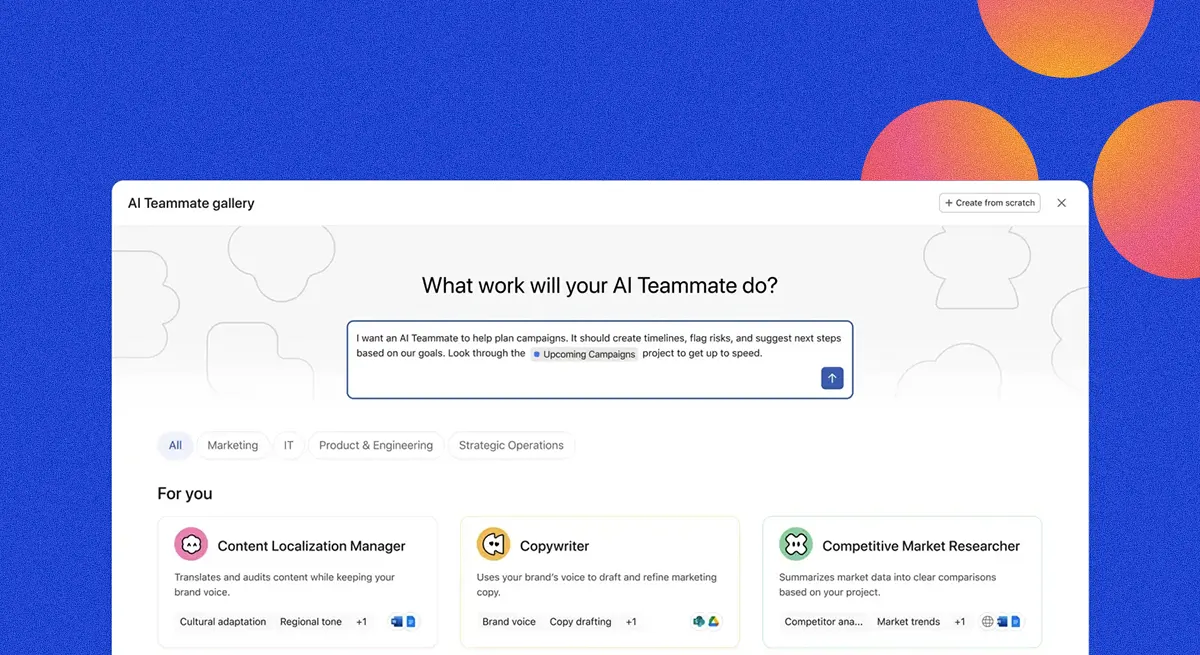
Because the agents sit directly on top of Asana's internal work graph, Ward says they function less like static search tools and more like active collaborators embedded into day-to-day workflows. The product marketing team uses an AI teammate designed to track launch timelines and map them directly to the corporate narrative. "People can actually interact with this particular agent and ask if the timeline has shifted," Ward explains. "They can ask how that timeline shift is actually going to impact the brand team and their deliverables and bill of materials. Or we can ask it from a communications point of view, 'Has the messaging shifted? Is the messaging doc more complete now? Has it had executive weigh-in?'"
The same infrastructure also powers executive communications workflows. By maintaining a centralized archive of all-hands meetings, interviews, and leadership content, Asana built agents capable of helping teams draft materials grounded in an executive's established communication style and historical thinking. Ward says one internally trained agent modeled after the company's Head of Product has become a particularly useful resource for early-stage brainstorming and thought leadership development. "It's almost like a mirror of him, and he's trained it to the point where we'll use that as our first port of call to chat with the agent and get a download," Ward notes. "We can ask what we would normally go to him with, like how he feels about a topic or requesting more insight into a specific thought leadership approach."
Planning before prompting
The real value of Ward's custom 7 a.m. briefing is not speed alone, but contextual awareness. The dashboard filters developments across the broader tech and AI landscape against Asana's internal priorities, upcoming interviews, and active thought leadership themes, so the communications team starts the day with a highly curated strategic view rather than a flood of disconnected headlines. Ward says the system works because it mirrors how an experienced communications leader already thinks about the information environment around the company. "You're literally telling the agent to pretend it's a strategic communications person whose sole focus by 7 a.m. is to review the landscape," Ward says. "We want to understand the macro climate, tracking big announcements in tech and AI well beyond our immediate category. You set it up to have this external worldview that you personally hold yourself."
Ward argues that automation hasn't diminished the importance of human judgment. If anything, it has elevated it. While AI can synthesize information and surface patterns quickly, she says determining what is actually meaningful still depends heavily on instinct, nuance, and contextual interpretation developed through years of communications experience. Those signals often emerge in subtle moments that structured data alone cannot fully capture. "We went to dinner with our CIO and some media last night, constantly drinking in the interesting little comments in the room, noting how people said things, and how it tied to a different topic," Ward reflects. "Then you bring it together with your own thinking about where the company should have strong opinions and where they shouldn't."
That balance between automation and judgment also shapes Ward's broader advice for communications teams experimenting with AI. Rather than building large collections of disconnected tools, she encourages organizations to start by identifying the operational bottlenecks that consume the most time and coordination effort internally. For many teams, that means mapping complicated workflows involving agencies, executives, and cross-functional stakeholders before introducing any AI layer on top of them. "You can have five or six agents, but really you don't need that many," she explains. "If you sit down as a team and think about yourselves as a communications group, as a service within the business that needs to hit ROI for the company, there are certain things you need to do. It's faster to identify those in the beginning and be more collaborative in how you plan."
Junior staff, senior context
One concern surrounding AI adoption inside communications is whether automation could weaken the development pipeline for junior talent by removing too much foundational work. Ward sees the opposite happening. She argues that shared AI systems can actually accelerate strategic learning by giving newer employees faster access to institutional memory, executive thinking, and historical company context that previously took years to absorb organically.
At Asana, tools like the shared 7 a.m. briefing and centralized executive content libraries expose junior team members to how senior leaders analyze industry trends, shape narratives, and frame customer challenges. Ward recalls one recent hire using the company's executive content library to quickly prepare for internal meetings by querying recent CIO messaging and customer themes. "She was able to ask the content library and the agent what our CIO has been talking about recently, and the big trends and pain points that he's been positioning as he's hearing from customers. It accelerates her ability to get that information, and she felt more intelligent quickly going into meetings with these people because she could catch up quickly."
Ward says the shift doesn't eliminate the need for foundational communications skills so much as it changes where junior employees spend their time. Instead of getting buried under repetitive research and administrative work, teams can move earlier into higher-level editing, synthesis, and strategic interpretation. The mechanics of communications still matter, but the emphasis increasingly shifts toward judgment, perspective, and connecting ideas in meaningful ways. "While junior staff avoid grinding away at the initial busywork, they still must put pen to paper, edit, and evaluate," Ward concludes. "You can't get away from the fact that you do need the human there doing the better, visionary thinking, and tying it all together. You can't automate that kind of knowledge."