RCS and Voice AI Create a Single Customer Journey That Most Enterprise Stacks Cannot Deliver
Michael W Nelson, Director of Global Strategic Partnerships at Vonage, explains why RCS, voice AI, and AI agents are converging into a continuous customer journey that most enterprises cannot deploy because marketing, CX, and CRM platforms still operate in separate technology silos.
Make The Intelligence Record one of your go-to sources on Google


You have this convergence of a lot of different technologies. You have RCS, you have voice AI, and you have AI agents. The challenge is that most enterprises probably have a lot of legacy data silos and technology stacks.

The technology to deliver a continuous, multimodal customer journey already exists. A customer can start in a branded RCS message, interact with buttons and carousels, escalate to a conversational AI agent, hand off to a human with full context, and receive a voice callback, all within the same conversation. That experience can be built and demoed today. But most enterprises cannot deploy it because marketing, CX, and CRM platforms still operate in separate technology lanes, and the data required to keep context intact across channels sits in disconnected systems.
Michael Nelson is Director of Global Strategic Partnerships at Vonage, whose communications API platform powers voice, messaging, and video. Nelson has spent over 30 years in enterprise communications, including 15 years running his own call center software company, and now leads Vonage's integrations with Salesforce, Adobe, HubSpot, and Moengage on the API side. He sees the convergence clearly but is blunt about why enterprises stall.
"You have this convergence of a lot of different technologies. You have RCS, you have voice AI, and you have AI agents," Nelson says. "The challenge is that most enterprises probably have a lot of legacy data silos and technology stacks."
SMS trust is broken
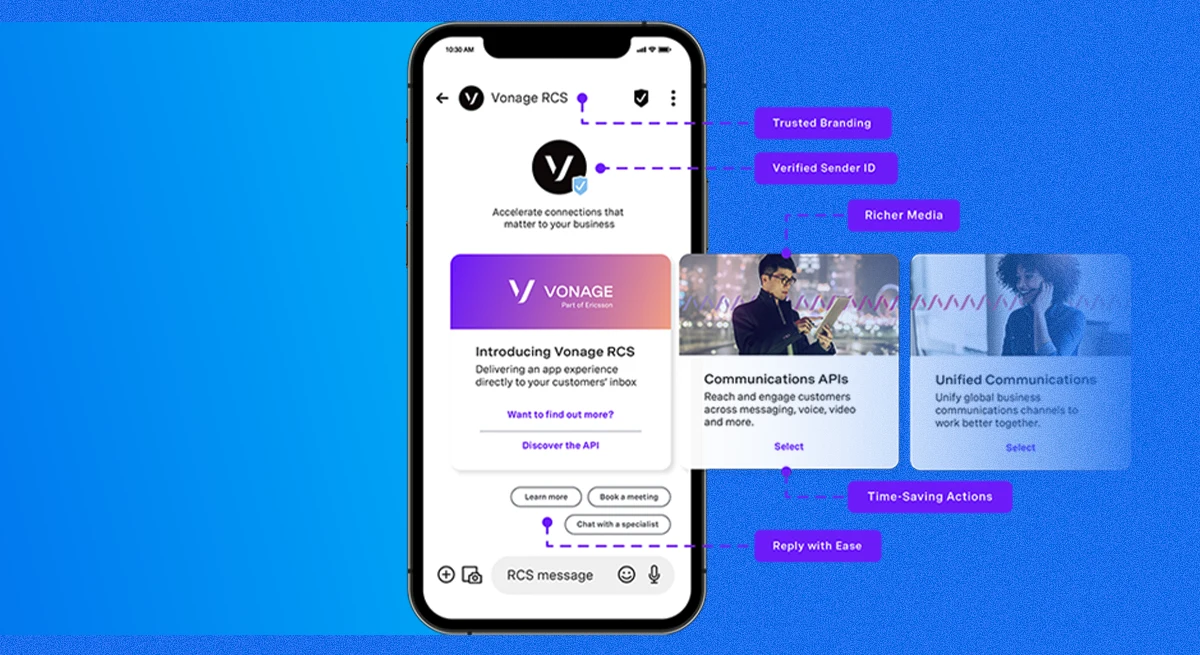
Nelson positions RCS as the channel that replaces SMS for both notification and conversational use cases. The message arrives branded, verified, and rich with interactive elements in the customer's default messaging app. "I don't trust SMS anymore. I get an SMS and I'll never click the link," Nelson says. "When you have branded rich messaging for notification compared to SMS, it's more secure, it's more trusted."
The cost question comes up immediately. RCS is more expensive per message. Nelson's response is the ROI math. "Let's say it's double the cost, but if I'm getting four times the results, it's a business decision," he says. "Sometimes people get sucked into the cost comparison."
For marketing, the comparison runs against spray-and-pray campaigns: a million SMS messages or emails sent with low engagement versus branded conversational flows with buttons, carousels, calendars, and callbacks that keep the customer in a dialogue. "Nine times out of ten, when I talk to marketers, they don't even know what RCS is," Nelson says. "We're at that hockey stick moment."
Context stays intact across channels
The real differentiator is not any single channel but the ability to maintain conversation context as customers move between them. Nelson describes a Google initiative where a user browsing on mobile sees a search result with a "click to chat" button that starts an RCS conversation. The context from that chat can be handed off to an AI agent and eventually to a human representative who receives the full history.
"Then you say, I need to speak to somebody. A few minutes later, your phone rings," Nelson says. "The person calling could be a virtual voice AI agent or a human, but they have the history of your conversation."
He tested this himself with United Airlines' RCS virtual agent. The agent transferred him from AI to a live human who resolved his issue. But when he asked for a callback, the system could not support it. "They said, 'I'm sorry, we don't support callback.' I said, 'You can do it. We're doing it. We have demos,'" Nelson says. The gap between what the technology supports and what enterprises have deployed remains wide.
Start with one pain point
Nelson advocates a crawl-walk-run approach rather than waiting for a full stack overhaul. Pick the highest-volume pain point inside an existing platform. For Salesforce Marketing Cloud, that might be abandoned cart recovery, loyalty program signups, or opt-in campaigns. Set up an RCS agent, configure the connector, and run a pilot against SMS and email on the same use case with AB testing.
"It's not hard to get started," Nelson says. "You can go to Vonage's portal and sign up for RCS and have a test agent within an hour." The barrier is not the technology setup. It is the organizational alignment required to bring marketing, CX, and CRM teams together around a shared journey rather than defending separate channel ownership.
"Who owns the customer engagement is another question," Nelson says. "They're all trying to fight for control." Until that alignment happens, the multimodal journey that the technology already supports will keep stalling in the demo environment.