The Data Was There, The Warning Wasn't: The Connection Failure Behind America's Disaster Alerts
The information to warn people almost always exists before disaster strikes. The failure that costs officials the public's trust is the warning that never reaches them in time.
Make The Intelligence Record one of your go-to sources on Google


People expect government to work for them. They don't have the awareness of the elegance of the systems that are in place, and frankly the lack of redundancy.

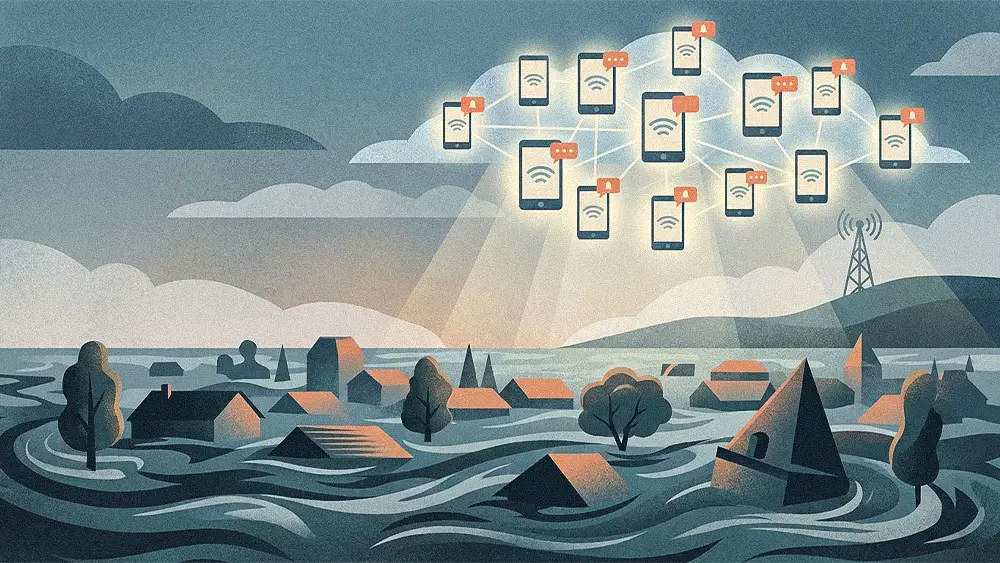
When the water came up around San Jose in the middle of the night, thousands of people learned they were in a flood zone the same way: they saw the boats. Firefighters in the streets was the first warning many residents got that they were supposed to leave. More than fourteen thousand people were ordered out as Coyote Creek overran its banks, and for a large share of them the order arrived after the water did, or not at all.
Clearly, something had gone wrong. "If the first time that a resident is aware that they need to get out of a home is when they see a firefighter in a boat," Mayor Sam Liccardo said, "then clearly there's been a failure." And it wasn't that no one saw it coming. The National Weather Service had tracked the storm, and the water district was watching the creek climb toward the top of its banks. The danger was known, hours ahead, by the people whose job it is to know. It's the last step that failed: the one that carries a warning from the agencies who have it to the person standing in the water's path.
The silence, not the storm
When something goes badly wrong, the assumption is usually that it was inevitable. Out of anyone's hands. Floods crest, fires run, transformers fail. What breaks trust is something else: the discovery, afterward, that someone could have said something in time and didn't. The disaster plus the silence is what curdles into a betrayal.
The trouble is that from the inside, the silence never looks like a failure. No one in government decides not to warn people. The warning just falls through, somewhere between the agency that saw the danger and the person exposed to it.
And it isn't for lack of a tool. The federal alert system can push an evacuation order straight to every phone in a targeted area, sound an alarm, and tell people where to go. Yet many officials use it either too late or not at all, and it doesn't stem from malice. The software that lets a local government send those alerts can cost tens of thousands of dollars that many communities simply don't have. The ones who do often lack the training to use it under pressure, or the confidence to make the call quickly, for fear of crying wolf. With a disaster bearing down, an emergency manager faces a blank text box and one nagging fear, as University at Albany researcher Jeannette Sutton put it: "What if I send out this alert and the threat turns out to be a big dud? Then they're going to get a lot of people who are really mad."
So the tool exists and the danger is visible. The gap holds anyway, because the machinery that should turn a known threat into a public warning is fragmented, expensive, and left to a single stressed person to trigger in the worst minutes of their career.
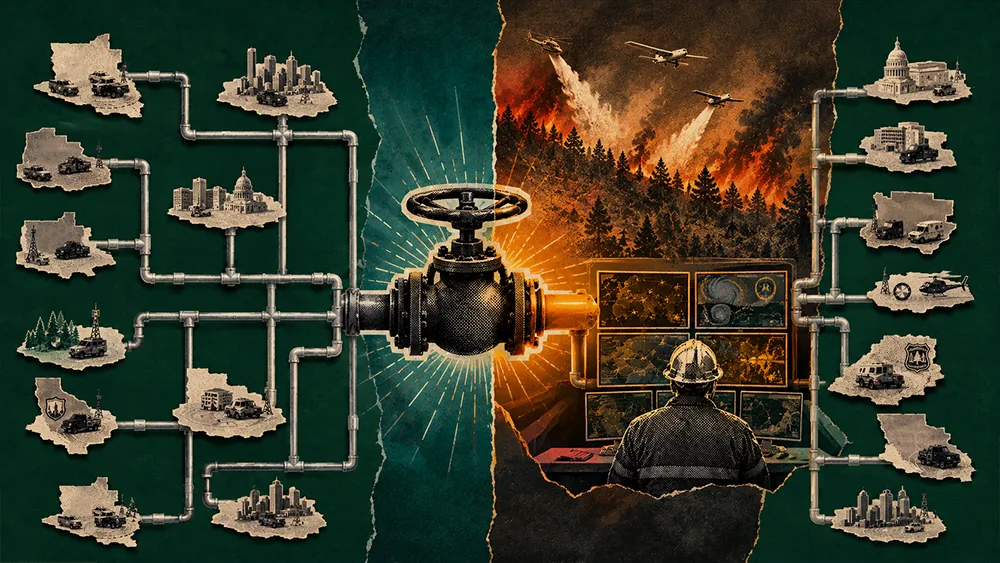
That gap is where Ankur Laroia has spent his career. Laroia advises Polaris I/O on public sector work and serves as a presidential appointee to the White House Office of Science and Technology Policy. "The data almost always exists," he says. "It's sitting in a dozen systems that were never built to talk to each other. The hard part is connecting it fast enough to see what's happening while you can still act on it." That's the problem Polaris works on: connecting fragmented data scattered across agencies, systems, and sensors, surfacing the pattern in it, and helping people decide earlier than they otherwise could.
When the warning never comes
The stakes here are not hypothetical.
When wildfires tore through Sonoma County, officials never sent the alert that forces a warning onto every phone in the fire's path; the county's emergency manager had decided the year before not to use it, wrongly believing it couldn't be targeted to a single area. Twenty-four people died and nearly 5,300 homes burned. Afterward, the records filled with residents demanding to know why they'd received no official warning at all. "You made no choice, and now the thousands of lives that are shattered can never be replaced," one wrote. "The blood and anger and sadness is on your hands."
The pattern repeats. When flash floods hit the Texas Hill Country, the National Weather Service sent its warnings. But the decision to order an evacuation belongs to local officials, and in the hardest-hit county that order came long after the water had already swept through. The information existed. It moved through the federal system as designed. It just never completed the last step, where a local official turns a forecast into a message that reaches the people who need it. More than a hundred people didn't make it out.
The invisible contract
Part of what makes these failures so devastating is that they break a promise no one remembers being made. People move through their days on an unexamined assumption that the serious things are handled, that someone is watching, that a warning will come if one is needed.
Laroia sees the assumption clearly. "People expect government to work for them," he says. "They don't have the awareness of the elegance of the systems that are in place, and frankly the lack of redundancy."
The expectation is built on a competence the public never has to verify, right up until the moment it fails. And when it fails, the gap between what people assumed and what was actually there is the size of the outrage.
The deeper cruelty is that the same competence, when it works, earns nothing. When the warning goes out early and people move in time, the disaster just never materializes. There's no headline for the evacuation that went smoothly, no award for the fire that never jumped the ridge, no reelection won on the blackout that stayed a rumor. The official who prevents a catastrophe gets silence. The official who presides over a visible one gets their name in the after-action report. Often it's the same person doing the same job, and the only variable is whether the thing they prevented was ever seen. Success, in this line of work, is a non-event, and non-events are impossible to take credit for.
The message is the mission
Which points at what the job actually is, underneath the sensors and the models and the response plans. Laroia frames the goal not as preventing every crisis, which no one can promise, but as being straight with people before, during, and after.
"Being proactive about managing a crisis, or preventing one, means being able to publish out what's happening so people can wrap their heads around it," he says. "You give them the five things you're doing right now, what you've already done, and what they need to do themselves." He's insistent that it be plain. A warning only works if everyone it reaches can act on it, which means writing it so it's clear the first time, under stress, with no room to misread.
Done well, this is what lets an official rise to a bad moment instead of being buried by it. It comes down to closing the distance between what the government knows and what the public is told. That distance shows up as a communication problem, but it starts earlier. The knowledge is already there, sitting in separate systems that don't talk to each other, and someone has to connect it, see the pattern, and decide what to do while there's still time to say it.
What keeps these gaps unsolved is money, and the money follows the same logic as the credit. The visible crisis gets funded without argument. The invisible prevention is a fight every time. The federal government obligates roughly seven dollars on response and recovery for every dollar it spends on mitigation, even though a Pew study found that every dollar spent on mitigation saves six in future losses. The same analysis notes something more damning still: the reliable availability of relief money after a disaster may actually discourage spending to prevent one.
Laroia has watched it from the inside. "We're really good at throwing people and money at it in a crisis," he says. "We won't spend on prevention, but the moment it hits the fan, we just throw money at it." The drama is fundable because it's visible. The prevention isn't, because when it works, there's nothing to see.
From knowing to telling
None of this requires government to become all-seeing. The pieces already exist. What's missing is the connective step: pulling scattered data into a single picture, recognizing what it means, and reaching a decision fast enough that a warning can still go out while it matters. The alert channels are already built. What keeps failing is everything upstream of them, the work of turning what a dozen systems separately know into one clear call in time to make it.
Which returns to the boats in the streets of San Jose. The failure there wasn't the creek, it was that people found out from the water instead of from the county. The public isn't asking government to be all-knowing, or to stop every flood and fire. It's asking government to connect what it already knows quickly enough to recognize the danger, decide what needs to happen, and tell people while there's still time to act.